
Imagine a potential customer nearby searches online for exactly what your business offers, but instead of finding you, they find a competitor. It’s probably not hard to believe that this happens to local businesses every day.
So how do you make sure customers find your business?
The answer is local SEO. Local SEO determines who shows when someone searches for a nearby service, and it offers huge potential for small businesses looking to grow.
Here’s a beginner-friendly guide to getting started.
What Is Local SEO (And How Is It Different from Regular SEO)?
SEO is all about being found on Google, without paying for ads. It’s the process of improving your website so that search engines show it to people who are looking for relevant information, products, or services.
Local SEO takes that one step further. It’s the process of improving a business’s online visibility so that nearby customers can find you on Google Search, Google Maps, and other search engines.
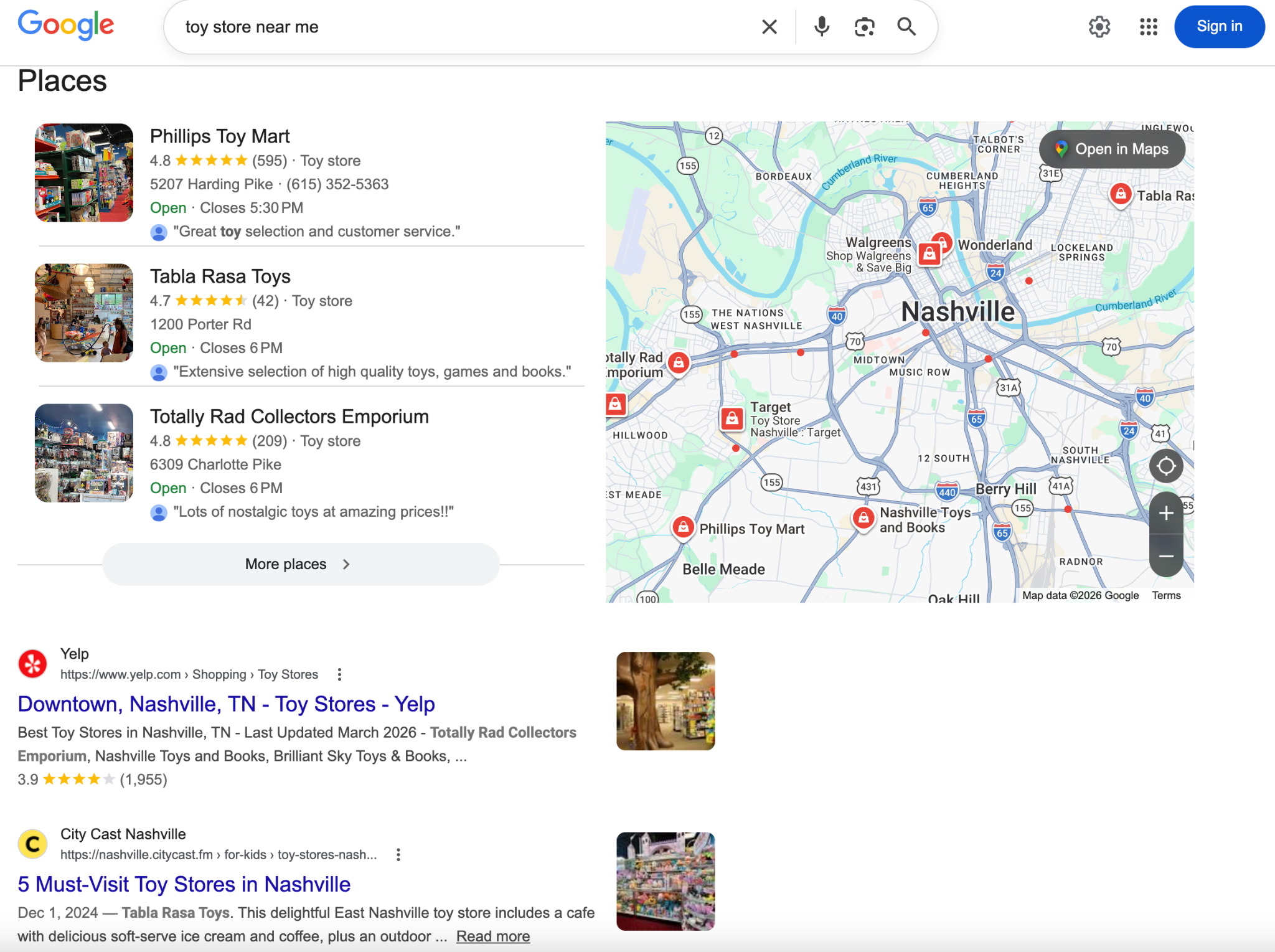
Here’s a simple example: imagine two toy businesses. One sells products nationwide online, and optimizes for broad keywords like “board games” or “dinosaur toys.” The other is a local toy store that optimizes for keywords like “toy store near me” to attract in-person shoppers. These businesses are in the same industry, but they have very different strategies.
Local searches also trigger a “Map pack” at the top of Google’s search results, showing three prominent business listings alongside a map. That map pack gives local businesses an additional opportunity to be seen and capture website clicks.
That’s the key difference between traditional and local SEO.
Why Local SEO Matters for Small Businesses
Local SEO is one of the most valuable tools available to small businesses. It helps new customers find you, drives foot traffic and calls, and ultimately impacts your bottom line.
People are actively searching for local businesses online; one study found that 80 percent of U.S. consumers do so weekly. They’re looking for contact information, photos, reviews, and other trust signals. Businesses with strong local SEO rank higher in these searches. Businesses without it miss out on these opportunities entirely.
Plus, local SEO levels the playing field. A small business can outrank a well-known chain store if its online presence is better optimized. Despite that potential, research shows that more than half of businesses still don’t have a plan to improve their local search rankings, which means the opportunity is wide open for those who do.
What about AI Search?
Google remains the top platform for local business recommendations, so traditional local SEO is still essential. But AI-powered search is growing quickly. A 2026 study from Brightlocal found that 45 percent of people now use tools like ChatGPT to find business recommendations — up from just 6 percent of people last year.
Consumers are using a mix of platforms to search for businesses and reviews, so it’s important for digital marketing strategies to include tactics for both SEO and GEO (generative engine optimization). The good news: many of the best practices for local SEO also support GEO performance, so you’re often building both at the same time.
Want to go deeper on AI search? Read our post about the future of SEO and AI search.
The Building Blocks of Local SEO
Local SEO works to improve your rankings by helping Google and your customers understand what your business does and where it’s located. It also helps demonstrate that your business is legitimate and trustworthy.
There are several key factors that influence your business’s perception online.
1. Your Google Business Profile
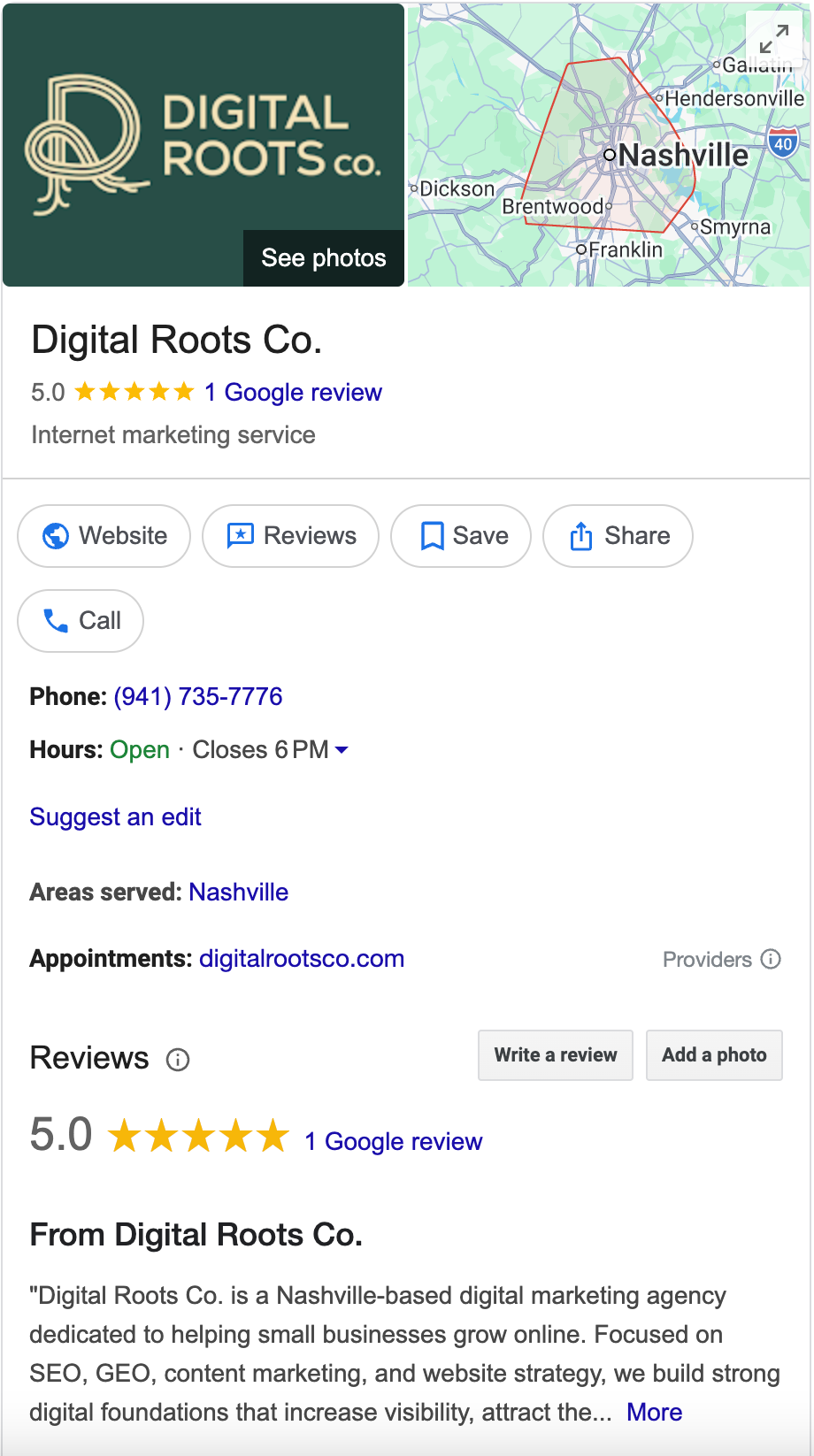
A Google Business Profile (GBP) is a free listing that gives you control over how your business appears on Google Search and Maps.
A complete, well-maintained profile lets you manage:
- Contact information: Business name, phone number, address, and website
- Hours of operation: Including special holiday hours
- Photos: Your logo, storefront, products, and work
- Customer reviews and engagement: Including your responses to reviews and customer questions
- Updates: Business posts, special offers, and announcements
Depending on the type of business, your GBP may also allow customers to book appointments, place orders, or call you directly from the listing.
Keeping your Google Business Profile accurate and up-to-date, builds trust, ensures customers have the right information, improves Google’s platforms, and drives conversions.
2. Your Website
Your website is the foundation of any SEO strategy. When it comes to local SEO, the goal is to clearly communicate who you are, what you offer, and where you operate.
A few practical ways to do this:
- Make sure your business name, address, and phone number (NAP) are listed on your website and match your Google Business Profile exactly
- Create dedicated landing pages for each product or service you offer
- Weave location information naturally into your page titles, meta descriptions, headings, and body copy ,without over-stuffing.
- If your business is service-based, list your service areas clearly on your website
- Add LocalBusiness schema, a type of code that helps search engines and AI platforms better understand specific details about a physical business (it is not seen by users on your website)
The key is to make it easy for both Google and your customers to understand where you are and who you serve. Make information easy to find, proactively answer users’ questions, and highlight the ways that your business meets their needs.
3. Online Reviews
Online reviews, especially Google reviews, directly influence your local rankings, Maps visibility, and how much potential customers will trust your business. They’re also one of the top factors consumers use when making purchase decisions, with 97% of consumers reading online reviews to guide their choices.
When people read reviews, they’re generally looking for a few things: consistency in how reviewers feel about a business, a meaningful number of reviews (20+), recency (posted within the last 1-3 months), and a strong star rating (4.5+).
As a business owner, you can manage your review presence by:
- Proactively asking customers to leave a review
- Focusing on the platforms their customers are most likely to use (Google, Facebook, and industry-specific websites)
- Responding to every review (both positive and negative) in a professional, helpful manner
4. Local Citations and Directory Listings
Local citations are mentions of your business name, address, phone number, and website on other platforms — think Yelp, Nextdoor, or industry-specific directories like Houzz (contractors), TripAdvisor (hospitality), or Zillow (real estate).
Building out your presence in these directories supports local SEO in a few key ways:
- Increased visibility:People searching within these platforms can discover your business, especially on niche directories where they're looking for something industry- specific
- Trust building: When search engines see your business listed consistently across multiple credible sources, it helps verify that your business is legitimate
- Backlinks: Links from credible websites signal relevance and authority to Google, which can improve your search rankings
As your business’s online presence grows across directories, so does your overall search visibility.
Common Local SEO Mistakes to Avoid
The good news about local SEO mistakes is that they're almost always fixable. Here are the most common ones to watch out for:
Inconsistent NAP Information
If your business’ name, address, or phone number differs across your website, Google Business Profile, and directory listings, search engines and customers may have trouble trusting business. This can often happen after a rebrand or a location move, so any time something changes, do a full audit of where your business is listed online.
An Incomplete Google Business Profile
If you haven’t claimed your profile or filled it out fully (including your business’s category, hours, description, and photos), you’re leaving rankings potential on the table. Take the time to make your profile as thorough as possible.
Ignoring Reviews
Responding to reviews (all of them) matters more than most people think. A professional, genuine response to a negative review shows future customers how you handle problems. A quick thank-you on a positive one shows you're engaged. And perhaps most importantly, these responses show future customers how they may expect to be treated by your business.
Don't skip this.
Skipping Keyword Research
Keyword research means identifying the terms your customers actually use to search for the products or services you offer. Tools like Google Keyword Planner (free), ChatGPT and other AI tools (free tiers available), and SEMRush (paid), can help. When evaluating keywords, pay attention to intent, and make sure what people are looking for matches what you provide.
Pro tip: To check a keyword’s intent, search for it on Google in an incognito browser and look at what’s already ranking. If the results are similar to what your business offers, it's a good fit. If not, keep looking for better keywords to target.
Keyword Stuffing
Including keywords on your website doesn’t mean forcing them in wherever possible or writing in a way that sounds robotic. Instead, include them naturally so that your content remains readable and useful. Search engines are good at understanding context, so clarity and helpfulness will always outperform stuffing.
How Long Does Local SEO Take to Work?
Local SEO is not a one-and-done task. Building visibility and trust takes consistent effort over time.
Some actions can show results relatively quickly, like claiming and completing your Google Business Profile. Others, like accumulating reviews and building out directory listings, take longer to compound into meaningful ranking improvements.
Every business is different, but it's realistic to expect six months to a year of consistent effort before seeing results that meaningfully impact your business. That timeline can feel long, but the gains are durable, unlike paid ads, which stop the moment you stop paying.
Tracking and Measurement
So how do you know if your local SEO is actually working? This is where tracking and measurement comes into play.
Here are a few places to look to know whether your local SEO is driving results:
- Google Business Profile Insights: Another benefit to having a Google Business Profile is the insights it gives you about your profile’s views, interactions, calls, bookings, website clicks, and more. Look at these metrics to understand how your GBP is helping your business.
- Website traffic: Tools like Google Analytics and Google Search Console provide data about how many visitors are landing on your website from search engines and can help you measure progress.
- Review growth: Pay attention to whether your review count and rating are improving over time.
- Customer feedback: Ask your customers how they found you, and notice when they mention Google, Maps, ChatGPT, and other search platforms.
Wrapping Up
Local SEO might seem like a lot to take on, but it's one of the highest-impact investments a small business can make in its online presence. You don't need to be a technical expert — you just need to understand the basics and commit to showing up consistently.
If you do nothing else this week, claim your Google Business Profile and start collecting reviews. When you're ready to go further, contact Digital Roots Co. for a free local SEO consultation.